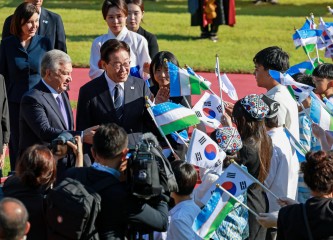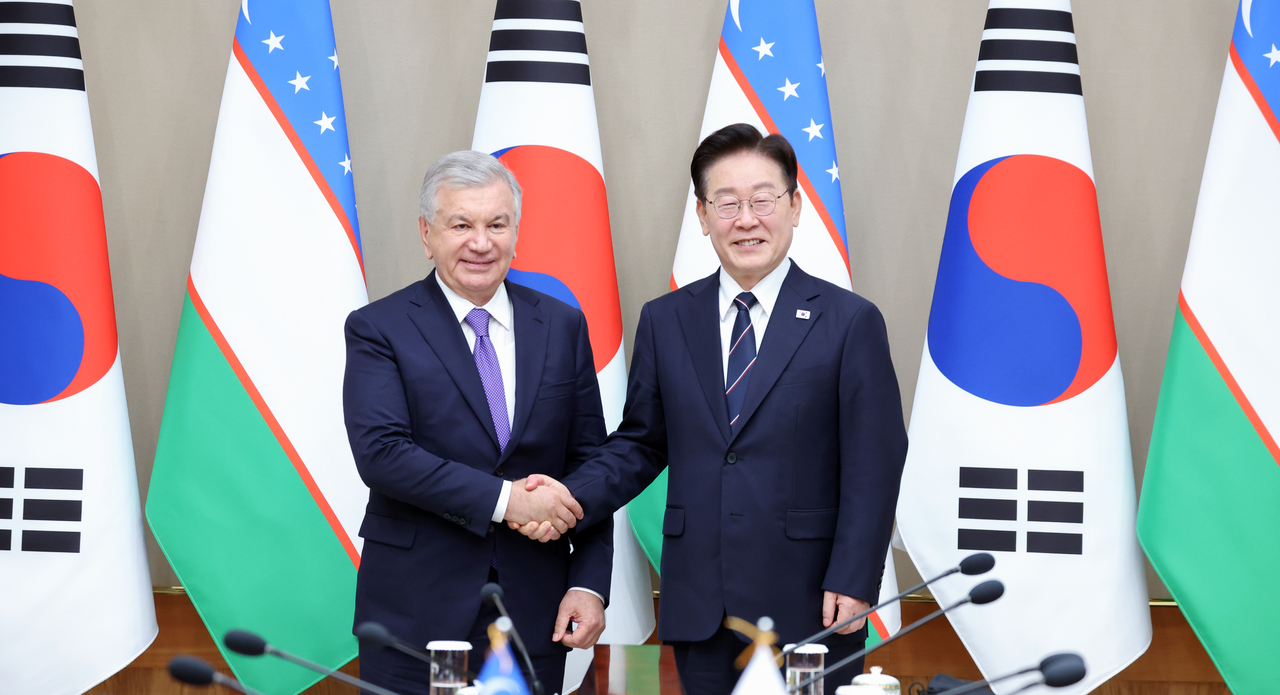
South Korean President Lee Jae Myung held summit talks with his Uzbek counterpart, Shavkat Mirziyoyev, on Monday and expressed hope that the two countries will further deepen their bilateral strategic partnership for mutual prosperity.
The summit was held in the run-up to Seoul's hosting of the inaugural South Korea-Central Asia Summit on Wednesday that will bring together the heads of state of Kazakhstan, Uzbekistan, Turkmenistan, Tajikistan and Kyrgyzstan to discuss cooperation.
Mirziyoyev was the first visiting president from the region to hold bilateral talks with Lee ahead of the multilateral summit
"Since establishing diplomatic relations in 1992, South Korea and Uzbekistan have built solid cooperative ties in various fields ranging from politics and the economy to the social and cultural fields," Lee said, highlighting Uzbekistan as the only Central Asian nation with which Seoul has a special strategic partnership.
He called Uzbekistan Korea's "precious friend and a key partner."
"I hope that the two countries, based on their accumulated deep friendship and trust, will develop their special strategic partnership more fully and march together toward mutual prosperity and peace," the South Korean president said.
The president cited traffic, infrastructure, healthcare, critical mineral supply chains, artificial intelligence and the defense industry, among others, where the two countries could work together to expand cooperation in a mutually beneficial way and generate future growth.
Lee highlighted the important roles the two countries could play in dealing with increasing global security uncertainties, adding that bilateral cooperation would also greatly help ensure peace and stability on the Korean Peninsula.
President Mirziyoyev said Uzbekistan has special affection for Korea and its people, saying the two countries' peoples share similar sentiments and traditions.
The two countries, in particular, share common challenges and priorities, the Uzbek president noted, citing public well-being as their common principle and saying this binds the countries together.
He also highlighted the thriving bilateral partnership in the economy and the international community, saying Uzbekistan will unwaveringly support Seoul's efforts to build peace and stability on the peninsula.
"As history has proved, our bilateral ties do not falter with political changes. We have continued to maintain equal, mutually beneficial and friendly ties," he said, expressing hope that his ongoing visit to Korea will serve as an opportunity to inject new momentum into their special strategic partnership.
In a subsequent press release, Korea's presidential spokesperson Kang Yu-jung said Lee and Mirziyoyev agreed to continue cooperation in transportation and logistics infrastructure sectors as well as the defense industry.
They, in particular, agreed to enhance cooperation to help Korean companies actively join Uzbek infrastructure projects, based on their past participation in airport construction in the Central Asian country, Kang said.
Both leaders concurred on the importance of establishing systems favorable for Korean firms operating in Uzbekistan in order to sustain bilateral trade and investment, welcoming the upcoming launch of a "Korea desk" at the Uzbek government as well as a South Korea-Uzbekistan committee of business consultation.
They also committed to pursuing cooperation in new areas, including critical minerals and the transition to AI and digital technology, while resolving to continue cooperation in jointly fighting the desertification of the Aral Sea and water shortages gripping Uzbekistan.
As part of the summit, the two countries signed a total of 13 memorandums of understanding and pacts to enhance cooperation between their governments in sectors including critical minerals, food and transportation, the presidential office here said.
One of the MOUs, signed between the Export-Import Bank of Korea and the Ministry of Investment, Industry and Trade of the Republic of Uzbekistan, calls for securing business opportunities in six strategic industries in Uzbekistan, including critical minerals, data centers, smart cities and biotechnology.
Other MOUs respectively call for increased cooperation in the tourism sector, the transfer of Korean agricultural technology and cooperation in regulations regarding medical products, according to the presidential office. (Yonhap)